
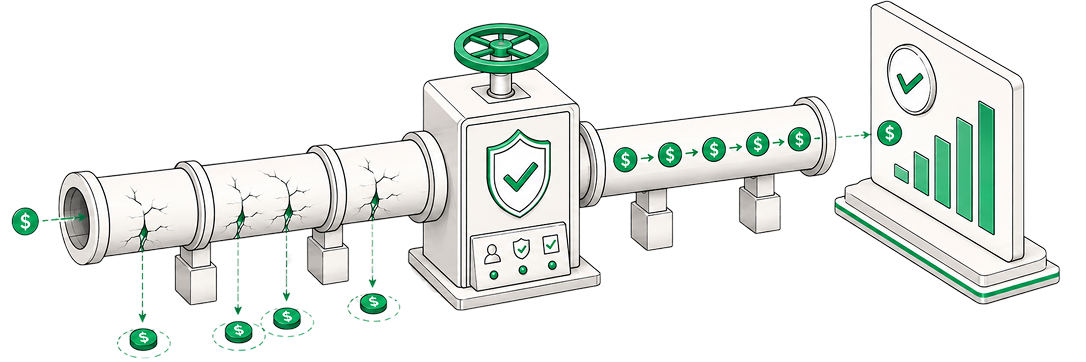
Many mid-market B2B organisations treat revenue leakage as a finance issue rather than a commercial operating issue. They look for leakage after it appears in margins, pricing reports, or customer profitability reviews. In reality, revenue erosion often begins much earlier—at the points where sales commitments, delivery realities, customer expectations, and contractual boundaries fail to stay aligned.
Many mid-market B2B organisations treat revenue leakage as a finance issue rather than a commercial operating issue. They look for leakage after it appears in margins, pricing reports, or customer profitability reviews. In reality, revenue erosion often begins much earlier—at the points where sales commitments, delivery realities, customer expectations, and contractual boundaries fail to stay aligned.
The Operational Application
To transition from passive leakage to active pipeline governance, implement three strict operational guardrails:- Commercial Boundary Triggers: Establish predefined commercial triggers where changes in customer requirements, delivery complexity, timelines, or specifications automatically trigger a commercial review.
- Decision Rights and Commercial Agility: Define the boundaries within which customer-facing teams can make commercial decisions without unnecessary escalation. Measure where teams are empowered to resolve customer issues quickly versus where decisions become stalled due to unclear ownership. Create explicit guardrails around pricing exceptions, scope changes, service commitments, delivery adjustments, and customer concessions. The goal is not unlimited flexibility—it is enabling teams to protect customer relationships while preserving commercial discipline.
- Leakage Visibility Reviews: Regularly review where value is being created without being captured—unbilled effort, delayed payments, excessive customisation, warranty exposure, or unmanaged service expectations.
Revenue leakage rarely happens through one large failure; it accumulates through thousands of small exceptions that become normalised. Strong commercial governance protects both customer relationships and the economics required to sustain growth.