
As mid-market B2B organisations scale, complexity accumulates quietly. New systems are added, approval layers increase, vendors multiply, and internal processes become increasingly difficult to challenge because they are familiar.
Shared services, technology platforms, operational workflows, and legacy investments often continue to exist not because they actively improve business performance, but because they have become embedded into the organisation. This creates a hidden commercial tax. Teams spend more time navigating internal friction than creating customer value. Sales cycles slow down, delivery teams carry unnecessary administrative burden, and leadership loses visibility into where resources are actually creating impact. The result is an organisation that appears larger but becomes less agile.
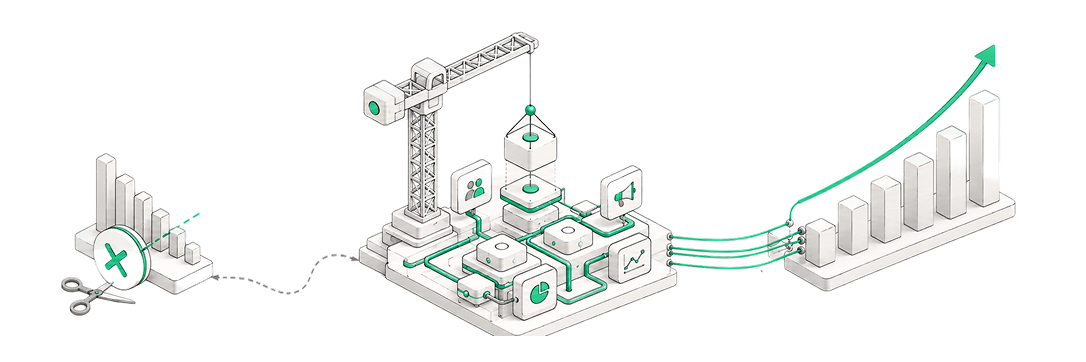
Operational efficiency is not about reducing costs indiscriminately. It is about ensuring that every investment, process, and shared capability strengthens the organisation’s ability to create, capture, and deliver value. High-performing organisations treat internal infrastructure as a growth engine—not a support function. Every technology investment, workflow, vendor relationship, and internal service should answer a fundamental question: does this improve commercial outcomes, operational capacity, customer experience, or strategic advantage? If the answer is unclear, the organisation is carrying complexity without corresponding value.
This becomes increasingly important as businesses scale. Growth amplifies both strengths and inefficiencies. A poorly designed operating layer does not remain a small inconvenience—it becomes a structural constraint that reduces speed, margins, and execution quality. To build commercial infrastructure that supports scale, establish three operating principles:
- Move from Cost Management to Value Management Review every shared service, technology investment, and operational capability based on measurable contribution—not historical precedent. Evaluate:
- Actual utilisation
- Business impact
- Revenue enablement
- Productivity improvement
- Customer experience impact
- Design Workflows Around Commercial Velocity Many organisations lose momentum through unnecessary handoffs, duplicated reviews, unclear ownership, and fragmented decision-making. Simplify workflows by:
- Automating repetitive activities
- Removing redundant approvals
- Clarifying decision rights
- Creating faster escalation paths
- Align Commercial Costs With Value Creation As businesses adopt more technology, platforms, and external capabilities, pricing and investment models must remain aligned with realised value. Avoid structures where:
- Costs increase without corresponding business outcomes
- Teams pay for unused capacity
- Operational complexity is hidden behind bundled packages
- Legacy commitments prevent better alternatives
Whether managing software investments, operational services, manufacturing support systems, or financial infrastructure, the principle remains the same: resources should scale with the value they create. Growth does not slow down only because markets become harder; it often slows because internal complexity becomes heavier. Organisations that continuously align their infrastructure to value creation build the capacity to scale faster, respond quicker, and protect margins.