
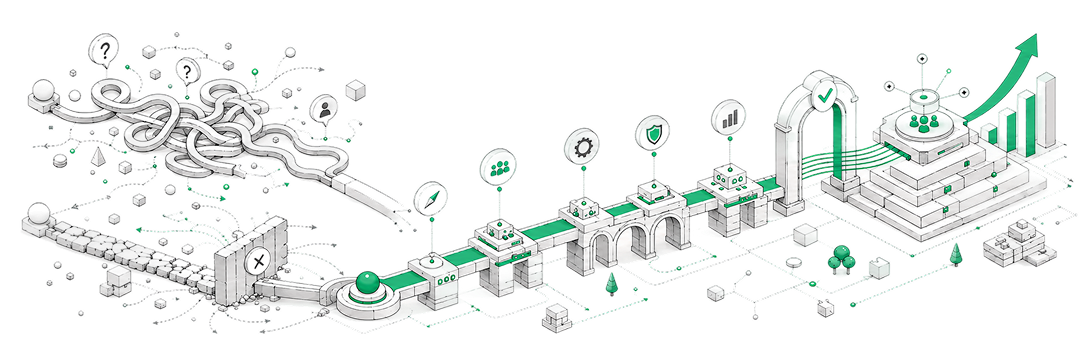
In scaling, mid-market B2B organizations, there is a constant, systemic friction between business units and internal risk/governance teams. Business units move with a mandate of speed, market velocity, and aggressive pipeline capture. Governance, legal, and brand teams operate on a mandate of protection, quality assurance, and risk mitigation. When a business needs to quickly shift its market positioning, run agile experiments, or launch a lean diagnostic tool to generate immediate pipeline, internal bureaucracy often stalls the initiative. In risk-averse environments, if a growth strategy does not seamlessly fit the legacy system, it is rejected.
When facing internal governance hurdles, growth rarely comes from pushing a high-risk “rebellious path,” nor does it come from succumbing to a slow, heavily diluted “approved path.” High-velocity breakthroughs require you to architect a Third Path—a creative operational workflow that reframes the problem so that risk teams have the visibility and confidence to support the initiative. You can unlock new growth opportunities without compromising your commercial discipline by separating market experimentation from high-friction operational commitments.
The Operational Application
To implement a high-velocity, governance-aligned GTM engine, create structured growth mechanisms that allow the organisation to test, learn, and scale without creating unnecessary operational risk.
- Build Low-Risk Market Entry Paths Instead of asking customers or internal stakeholders to commit immediately to a large-scale change, design smaller, controlled entry points that demonstrate value quickly. Depending on the business model, this could include:
- Targeted business assessments
- Solution evaluations
- Controlled pilots
- Proof-of-value programs
- Product trials
- Customer workshops
- Operational benchmarking exercises
- Convert Expertise and Capabilities into Repeatable Growth Assets Transform internal knowledge, customer insights, and operational strengths into scalable commercial assets that can support market engagement. These may include:
- Diagnostic frameworks
- Industry benchmarks
- Solution guides
- Assessment tools
- Configurators
- Maturity models
- Implementation roadmaps
- Customer success frameworks
- Design Governance Into the Growth Model Growth initiatives move faster when governance is built into the design rather than added as an approval layer at the end. Define clear boundaries around:
- Customer commitments
- Compliance requirements
- Delivery standards
- Pricing structures
- Brand positioning
- Operational ownership