
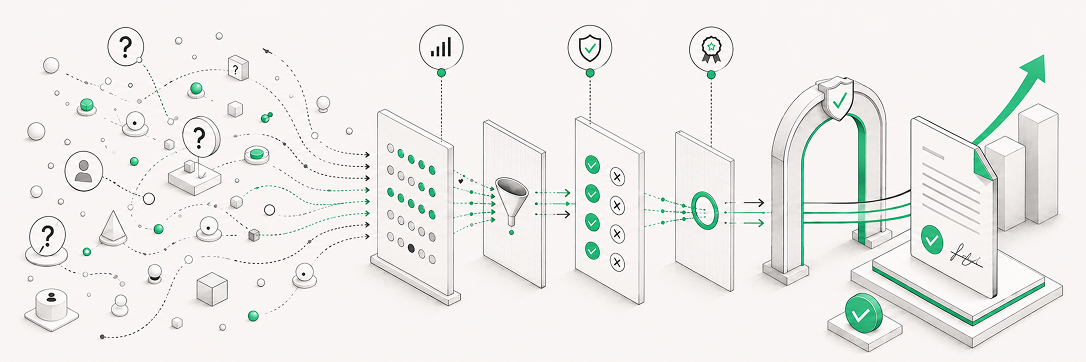
In complex B2B deals, the primary blocker to pipeline velocity isn’t your pricing or your competitor’s capability—it is the client’s internal perception of risk. When procurement criteria are unclear, implementation risk feels high, or the business impact is difficult to validate, prospective buyers delay decisions. They remain stuck in your pipeline as prolonged ‘open opportunities’. Most organizations misdiagnose this inertia as a price problem and aggressively discount their services to stay relevant. However, discounting only trains the market to perceive you as a commodity, destroying your margins and slowing down long-term revenue velocity.
To unlock pipeline velocity and capture enterprise accounts, you must realize that assurance beats affordability every single time. High-performing firms do not win by cutting prices; they win by defining and demonstrating a highly visible, credible standard that de-risks the client’s hiring decision. Think of it through a consumer lens: we don’t seek out the cheapest appliance; we buy the one with a visible, ironclad warranty because it signals structural reliability. In the B2B enterprise landscape, the player who deliberately sets a verifiable benchmark wins disproportionate trust without ever materially increasing their cost of delivery. Trust isn’t built on a promise of flawless perfection; it is built on a transparent framework of operational accountability that the client can explicitly feel.
The Operational Application
Accelerate enterprise outreach and ABM programs by embedding these three de-risking mechanisms into your commercial architecture — whether you sell expertise, technology, products, or outcome-led solutions.- Outcome-Backed Commercial Commitments Move beyond generic service commitments and define measurable business outcomes that demonstrate operational confidence. For services organisations, this could include turnaround times, implementation milestones, response commitments, or quality benchmarks. For manufacturing organisations, this could translate into:
- Equipment uptime commitments
- Preventive maintenance schedules
- Production efficiency improvements
- Energy savings targets
- Quality consistency benchmarks
- Lifecycle performance guarantees
- Structured Value Validation Programs Replace informal trials, demonstrations, or proof-of-concepts that create curiosity without commitment with structured validation programs designed around measurable business impact. For professional services and technology firms, this may be a paid diagnostic, maturity assessment, or transformation roadmap. For manufacturing-led businesses, this could include:
- A paid plant assessment
- Production optimisation study
- Lifecycle cost analysis
- Engineering feasibility review
- Solution simulation
- Pilot deployment tied to predefined success criteria
- Early Adoption Flexibility The early relationship phase is where trust is either created or lost. Rigid commercial boundaries at this stage increase perceived risk, especially when the buyer is adopting a new solution or changing an existing operating model. Create deliberate flexibility mechanisms such as:
- Initial implementation adjustments
- Phased deployment options
- Configuration refinement windows
- Process alignment workshops
- Transition support periods
For manufacturers introducing service layers around products, this is particularly important. Customers may understand the product value but remain uncertain about adoption, integration, or operational change. Removing friction early accelerates conversion and increases expansion potential.
In complex B2B markets, the strongest growth engines are not built on persuasion alone—they are built on reducing the uncertainty that slows customer decisions. Organisations that make trust visible through measurable commitments, structured validation, and commercial flexibility create momentum where others experience stalled pipelines.