
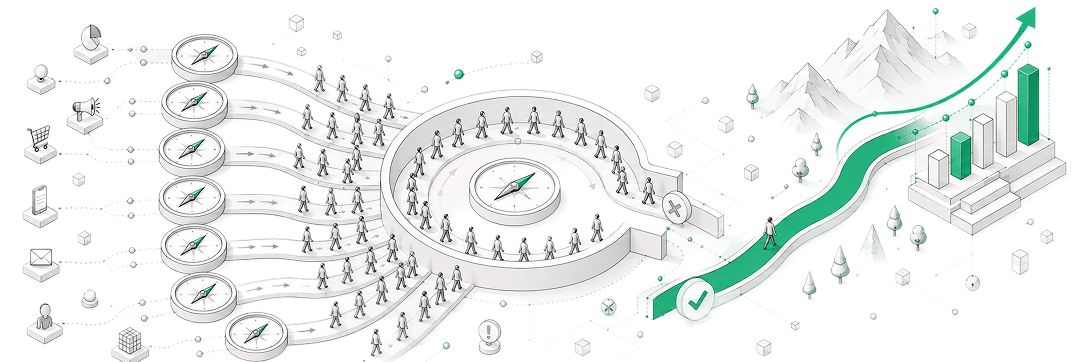
In scaling mid-market B2B organisations, competitive similarity is inevitable. When growth slows or markets shift, leadership teams often fall into the trap of competitive obsession. They monitor rival platforms, match their breaking updates, mirror their pricing models, and even replicate their presentation deck formats. This frantic rush to achieve parity destroys your strategic edge. When competition becomes your primary compass, your institutional judgment suffers, and you end up amplifying market confusion rather than capturing pipeline velocity.
True differentiation is never achieved by copying your rivals faster. In fact, reacting blindly to competitive pressures frequently dilutes your core unit economics and erodes your pricing power. Healthy margins are built on three foundational pillars: differentiated value, pricing power, and an operating model that scales efficiently. Every single time your organization shifts its positioning or introduces an unvetted service play just to match a competitor’s move, you introduce operational friction and dilute those core economics. Until your data confirms that client buying criteria have structurally and permanently transformed across your entire market segment, operational discipline beats competitive drama every day of the week.
The Operational Application
When reviewing your GTM strategy, repositioning an offering, or deciding whether to respond to competitive moves, filter every market signal through three strategic tests:- The Capability Reality Check: Are we losing opportunities because competitors genuinely offer a superior capability, outcome, technology, delivery model, or customer experience? Or are we losing because our value proposition is unclear and our commercial teams are failing to articulate the difference? A true capability gap requires investment in products, processes, talent, technology, or partnerships. A positioning gap requires sharper messaging, stronger proof points, and better customer conversations. Confusing the two leads to expensive and unnecessary market reactions.
- The Business Model Impact Test: Will this competitive response strengthen our long-term commercial advantage, or will it introduce complexity that weakens profitability, scalability, and operational focus? For services organisations, this may mean avoiding low-value customisation that increases delivery dependency. For technology and manufacturing businesses, it may mean avoiding feature expansion, pricing changes, or product variations that increase complexity without improving customer value. For financial services organisations, it may mean resisting risk-heavy offerings that dilute strategic focus. The goal is not to match every market move, but to protect the economics that make your business scalable.
- The Market Signal Trigger: Make major positioning changes only when there is evidence of a structural market shift—not because a competitor launched something new.Repositioning deserves serious investment when:
-
- Customer buying criteria have fundamentally changed
- A new category or business model is emerging
- Existing offerings no longer solve the customer’s priority problems
- Competitors have created a measurable advantage that affects win rates
- Your current operating model cannot support future growth
-
Strategic differentiation is not about being different for the sake of being different. It is about building a position that competitors cannot easily copy because it is connected to how your organisation creates value. Markets reward organisations that create clarity, not those that create noise. Sustainable growth comes from knowing which competitive signals deserve a response—and which ones are simply distractions from building a stronger business.