
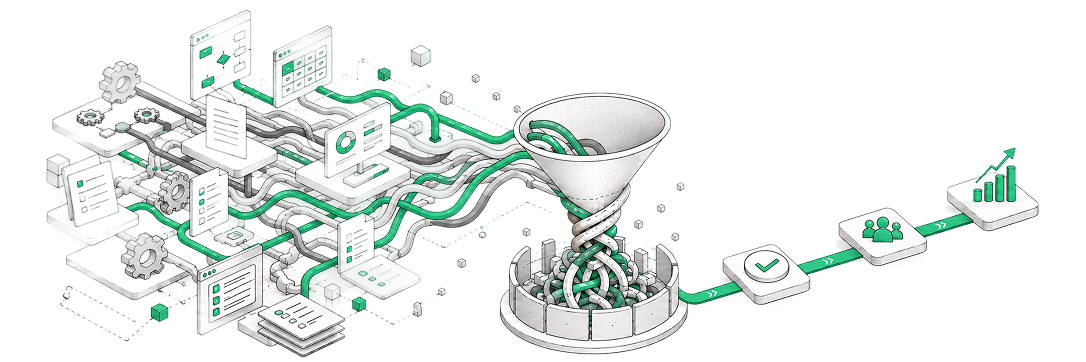
When growth-focused B2B organisations struggle to scale, the immediate instinct is often to add more structure. Leadership teams introduce new playbooks, workflows, approval mechanisms, technology platforms, and reporting systems with the expectation that better processes will automatically create better execution.
However, many scaling challenges are not caused by a lack of process. They are caused by unresolved strategic tension. One part of the organisation may be optimising for customer intimacy and flexibility, while another is pushing for standardisation, efficiency, and repeatability. Sales teams may pursue growth opportunities that delivery teams cannot absorb. Business units may request custom solutions that increase complexity without strengthening differentiation. In these situations, processes do not create alignment. They simply document the existing confusion.
The same challenge appears when organisations turn to technology. Leaders often invest in custom-built platforms because existing tools do not perfectly reflect their historical ways of working. Without a clear commercial model and operating philosophy, these technology investments become expensive attempts to preserve complexity rather than enable scale.
You cannot automate your way out of strategic ambiguity. Scalable organisations are not built by standardising everything. They are built by making deliberate choices about what should be repeatable, where flexibility creates value, and which capabilities genuinely differentiate the business. A successful operating model creates clarity around what customers should consistently experience, what teams should execute in a repeatable way, where exceptions are strategically valuable, and where the organisation must maintain discipline. Technology should then reinforce this model—not become a substitute for defining it. A custom system, workflow, or platform creates enterprise value only when it strengthens a capability that can scale, improve customer outcomes, or create strategic advantage. Building technology to accommodate inefficient processes simply accelerates inefficiency.
The Operational Application
To build a scalable commercial operating model, leaders should focus on three principles:- Clarify the Commercial Model Before Building Systems Before introducing new tools or processes, define the strategic choices that shape execution. Establish:
- What offerings should be standardised
- Where customer-specific flexibility is valuable
- Which activities create differentiation
- Which exceptions require deliberate approval
- Test and Simplify Before Automating Do not digitise workflows that have not been proven effective. Before investing significant technology resources:
- Test the process manually
- Validate adoption
- Identify unnecessary complexity
- Confirm that teams can execute consistently
- Invest in Technology That Builds Enterprise Advantage Technology investments should be evaluated through the lens of long-term commercial value. A platform or internal capability should either improve a critical business process at scale, create a measurable customer advantage, enable a repeatable commercial capability, or strengthen strategic differentiation. Technology cannot solve a behaviour or process problem. If the organisation is committed to changing how it works, an established third party platform can accelerate that transformation; if it is not, a custom build simply preserves old habits in a newer format.
True commercial maturity comes from designing an operating model where people, processes, and technology reinforce the same growth strategy. Scale does not come from adding more systems; it comes from removing the complexity that prevents organisations from operating consistently. The companies that grow sustainably first create strategic alignment, then build the processes and technology that amplify it.