
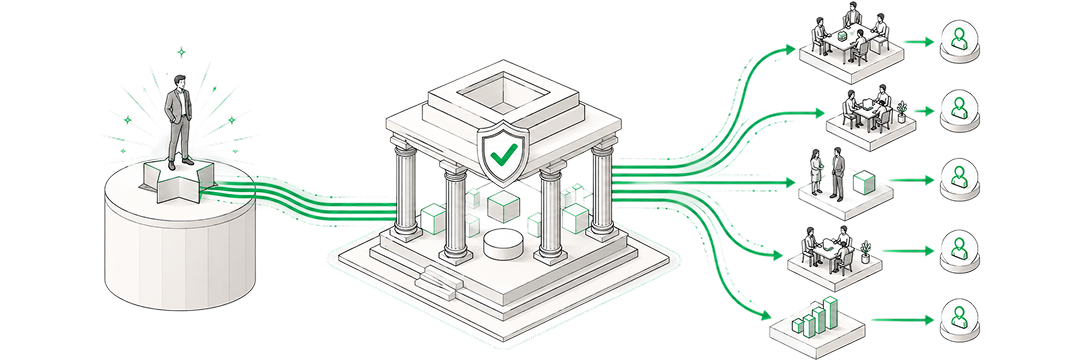
For mid-market founder-led and expert driven firms, the abrupt departure of a top revenue generator—a classic “rainmaker”—frequently triggers a systemic crisis. Because customer experience, institutional knowledge, and core relationships are tightly centralized within these key individuals, their exit can wipe out entire account portfolios and destabilize junior delivery teams overnight. Most leadership teams accept this vulnerability as an unalterable cost of doing business, mistakenly believing that high-tier enterprise relationships cannot be sustained without individual cults of personality.
Over-reliance on individual rainmakers is a structural flaw born from a failure to institutionalize client engagement and brand positioning. When a firm’s value proposition is tied exclusively to a person rather than a repeatable methodology, it surrenders its enterprise value. As businesses scale, the market must move from individual dependency to institutional trust—where customers value the organisation’s repeatable capabilities, not only the relationships of individual leaders.
The Operational Application
To insulate your commercial engine from talent churn and protect long-term enterprise valuation, operationalize the institutionalization of relationships via three distinct mechanisms:- Enforce Cross-Functional Client Touchpoints: Transition critical accounts away from solo management into team-based relationship frameworks. Introduce cross-practice managers to expand service visibility, ensuring the client binds to the firm’s broader portfolio.
- Democratize Methodology Through Service Productization: Document elite delivery blueprints and house them in a centralized, accessible repository. Forcing the codification of best practices accelerates go-to-market velocity while decreasing delivery dependence on single operators.
- Institutionalize Commercial Ownership Across Functions: Growth becomes fragile when customer knowledge, expansion opportunities, and relationship intelligence sit with only a few individuals or a single sales function. Create structured mechanisms that allow customer-facing teams across the organisation to contribute to commercial continuity without disrupting their core responsibilities. This includes:
- Enabling delivery, customer success, product, and operational teams to identify expansion signals and customer needs
- Creating clear handoff mechanisms between sales, account management, and delivery teams
- Embedding customer intelligence into account planning and growth reviews
- Defining measurable ownership for retention, expansion, and customer value creation
The objective is not to turn every employee into a salesperson. It is to ensure that commercial insight is captured systematically and converted into growth opportunities. Growth becomes fragile when commercial success depends on individual memory, relationships, or heroics. Scalable organisations convert expertise into institutional capability that survives leadership transitions and creates long-term enterprise value.